 ultimate-guide
Commercial Electrical Maintenance Plan Benefits
Table of Contents
- Why a Commercial Electrical Maintenance Plan Pays for Itself
- The Top 7 Benefits of Electrical Maintenance for Your Business
- Your Commercial Electrical Preventive Maintenance Checklist
- Electrical Maintenance Frequency for Businesses: How Often Is Enough?
- OSHA Electrical Safety Requirements for Businesses
- Calculating ROI and Navigating Insurance for Your Electrical Maintenance Plan
- Frequently Asked Questions
Last Updated: September 22, 2026
Why a Commercial Electrical Maintenance Plan Pays for Itself
A commercial electrical maintenance plan is a scheduled program of inspections, testing, and repairs that keeps a business's electrical infrastructure running safely and predictably. A commercial electrical maintenance plan is a scheduled program of inspections, testing, and repairs that keeps a business's electrical infrastructure running safely and predictably.
The Top 7 Benefits of Electrical Maintenance for Your Business
The benefits of a commercial electrical maintenance plan fall into seven categories, ranging from safety and compliance to direct cost savings. Each one reinforces the others, which is why partial fixes rarely deliver the full return.
1. Minimized Unplanned Downtime
Downtime is the most visible cost of deferred maintenance. A preventive maintenance program catches failing components before they take a circuit, a panel, or an entire building offline. Thermal imaging, load testing, and routine panel inspections reveal the weak points that cause unplanned outages. For businesses that can't afford a dark kitchen or a closed storefront, this alone justifies the program.
2. Enhanced Facility and Personnel Safety
Electrical hazards are among the most serious risks in any commercial space. Regular circuit breaker maintenance, torque checks, and inspection of aging wiring reduce the chance of shock, arc flash, and fire. Fire hazard mitigation is not a side benefit; it's the foundation of a safe workplace and a defensible facility management strategy.
3. Extended Lifespan of Electrical Assets
Electrical distribution systems age. Breakers weaken, insulation degrades, and connections loosen. A scheduled maintenance plan addresses these issues before they compound, which extends equipment longevity and defers major capital investment. Replacing a panel every 15 years instead of every 10 changes the long-term budget significantly.
4. Improved Energy Efficiency and Cost Savings
A well-maintained system wastes less power. Loose connections, failing breakers, and poor power quality all drive up energy consumption. When you track and correct these issues, operational efficiency improves and monthly utility bills often drop. Energy savings and reliability improvements tend to arrive together.
5. Regulatory Compliance and Code Adherence
Code compliance protects your business legally and operationally. Electrical safety standards, including those referenced in OSHA requirements and NFPA 70B, set the expectations for inspection and maintenance. A documented maintenance schedule gives you proof of due diligence during inspections, insurance reviews, or after an incident.
6. Fewer Emergency Repair Bills
Emergency repairs cost more than planned ones. They arrive after hours, require premium labor rates, and often involve rushed decisions. A preventive maintenance program converts most emergencies into scheduled work, which is both cheaper and less disruptive. That's the direct financial case for maintenance.
7. Better Equipment Performance and Long-Term Sustainability
Well-maintained equipment runs closer to spec. Motors draw less current, panels stay cooler, and systems respond predictably under load. That consistency supports long-term sustainability goals and reduces the environmental footprint of your facility's electrical infrastructure.
Your Commercial Electrical Preventive Maintenance Checklist
This is where most guides stop at theory. Here's the actual work a commercial electrical preventive maintenance checklist should cover, and how often.
- Monthly: Visual inspection of panels for heat, discoloration, or corrosion; test GFCI receptacles; check emergency lighting and exit signs.
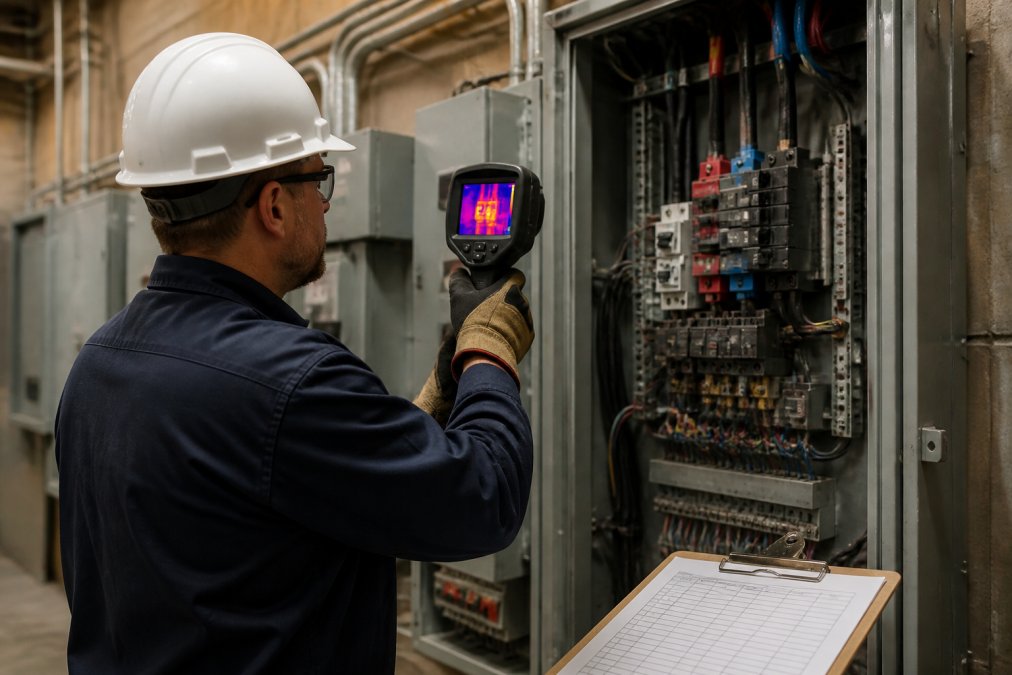
- Quarterly: Thermal imaging scan of panels and connections; torque check on main lugs; verify breaker labeling matches the panel schedule.
- Annually: Full panel inspection, load testing, and infrared survey; test automatic transfer switches (ATS); inspect and exercise main breakers.
- Every 3-5 years: Comprehensive electrical distribution system assessment, including power quality analysis and insulation resistance testing.
Electrical Maintenance Frequency for Businesses: How Often Is Enough?
Electrical maintenance frequency for businesses depends on equipment type, load, and environment, but the more useful question is which tier of maintenance you're buying. Frequency is a symptom; the tier is the decision.
The Three Tiers of Electrical Maintenance
Reactive (run-to-failure). You fix things when they break. Lowest upfront cost, highest total cost. Every event is an emergency, every repair is at premium rates, and every failure carries downtime and safety exposure. This is the default for facilities that haven't yet built a program.
Baseline Frequency by Tier
| Frequency | Task | Tier | Best For |
|---|---|---|---|
| Monthly | Visual panel checks, GFCI tests, emergency lighting | Preventive | All commercial facilities |
| Quarterly | Thermal imaging, torque checks, breaker labeling audit | Preventive | High-load or aging systems |
| Annually | Full inspection, load testing, ATS test, main breaker exercise | Preventive | Every commercial property |
| Every 3-5 years | Distribution system assessment, power quality analysis, insulation resistance testing | Preventive | Facilities over 15 years old |
| Continuous | Temperature, current, and partial-discharge monitoring | Predictive | Critical assets, 24/7 operations |
Facilities with heavy loads, older wiring, or dusty or damp conditions should move to a tighter preventive schedule, and should prioritize predictive monitoring on the assets whose failure would hurt most.
How Smart Building Tech Changes the Calculus
IoT sensors and remote monitoring are the biggest shift in commercial electrical maintenance in the last decade. Instead of waiting for a quarterly thermal scan to catch a hot connection, continuous monitoring flags rising temperature or abnormal current draw weeks before failure. That converts a potential emergency into a scheduled repair.
The practical benefits:
- Earlier detection. Trending data catches degradation that a single snapshot misses.
- Targeted response. You dispatch to the asset that's actually degrading, not the whole panel.
- Better records. Continuous data strengthens both your ROI calculation and your insurance file.
- Fewer truck rolls. Remote diagnostics reduce unnecessary site visits.
Matching Frequency to Risk
The right answer isn't a single number. It's a tiered schedule matched to risk:
- Low-criticality, modern equipment, light load: annual preventive inspection is often sufficient.
- High-load or aging systems: quarterly preventive plus targeted predictive monitoring.
- 24/7 operations or life-safety dependencies: predictive monitoring on critical assets, with preventive intervals tightened across the board.
OSHA Electrical Safety Requirements for Businesses
OSHA electrical safety requirements for businesses center on protecting workers from shock, arc flash, and other electrical hazards. Employers are expected to ensure wiring is safe, equipment is maintained, and workers are trained on electrical safety standards. The relevant rules sit in OSHA's electrical standards, and the maintenance expectations align with NFPA 70B.
Calculating ROI and Navigating Insurance for Your Electrical Maintenance Plan
Most articles on this topic tell you a maintenance plan "pays for itself" and stop there. That's not useful to a facility manager who has to justify the line item to a CFO. Here's the actual framework, plus the insurance and liability angle almost no one covers.
The ROI Formula
- Cost of unplanned downtime per hour, lost revenue + idle labor + spoilage or scrap + customer churn. For a restaurant, that's a lost dinner service. For a warehouse, it's stalled throughput. For a retail floor, it's abandoned carts.
- Average annual emergency repair spend, pull the last 24 months of after-hours invoices. Emergency labor typically runs at a premium over scheduled work, and rushed repairs often get revisited.
- Annual cost of the maintenance plan, the contract value, including scheduled inspections, testing, and documentation.
- Deferred capital replacement value, the panels, breakers, and switchgear you don't replace early because the plan extended their service life.
The working equation:
ROI = (Avoided downtime cost + Reduced emergency repair spend + Deferred capital spend − Plan cost) ÷ Plan cost
A Simple Worked Example
Suppose a facility experiences two unplanned electrical events per year, each costing four hours of downtime. If downtime runs $2,000 per hour, that's $16,000 in annual downtime exposure. Add $6,000 in emergency repair premiums and you're at $22,000 in reactive cost. If a preventive plan runs $9,000 per year and cuts unplanned events by roughly half, the math is straightforward, and that's before counting deferred capital or insurance effects.
Insurance and Liability: The Angle Most Guides Skip
Documented maintenance changes how underwriters and claims adjusters see your facility.
- Underwriting. Commercial property and general liability underwriters ask about maintenance programs because they are a proxy for risk management. A documented plan signals that you manage electrical risk rather than react to it. Many carriers offer credits or more favorable terms for verifiable programs, the specifics vary by carrier and policy, so ask your broker directly.
- Claims defense. After an electrical fire or injury, the first question is whether the loss was foreseeable and whether you exercised reasonable care. Dated inspection records, thermal imaging reports, and torque logs are evidence of due diligence. Their absence shifts the burden toward you.
- Subrogation risk. If your insurer pays a claim and later determines the loss stemmed from deferred maintenance, they may pursue recovery. Documented maintenance is your defense.
- Contractual exposure. Many commercial leases and vendor agreements require the tenant or operator to maintain electrical systems to code. A maintenance log is how you prove you met that obligation.
Skipping documentation because "nothing has gone wrong yet" is the most common mistake we see. When an inspector, underwriter, or attorney asks for maintenance records and you can't produce them, the burden shifts to you, and the consequences can include fines, denied claims, or higher premiums.
What to Track for Both ROI and Insurance
- Date and scope of every inspection
- Thermal imaging findings and remediation
- Torque values and re-torque records
- Breaker exercise and trip-test results
- Any deferred or recommended repairs, with disposition
This is the same record set that feeds your ROI calculation and your insurance file. Build it once, use it for both.
The ROI calculation isn't just about repair savings. It's downtime avoided, insurance posture improved, and asset life extended. Stack all three and the plan pays for itself well before the first emergency you never have to make.
Frequently Asked Questions
What is typically included in a commercial electrical maintenance plan?
A commercial electrical maintenance plan usually covers panel and circuit breaker inspections, thermal imaging, load testing, tightening connections, cleaning and testing equipment, checking emergency lighting and generators, and reviewing power quality. It also includes documentation of every inspection and repair. Plans are often tiered, from annual checks to quarterly or monthly service for high-use facilities.
How often should a business schedule electrical maintenance?
Most businesses should schedule electrical maintenance at least annually, but the right frequency depends on your operations. High-use facilities like restaurants or manufacturing plants often need quarterly or monthly service. Your electrical maintenance frequency for businesses should also consider equipment age, past issues, and manufacturer recommendations. A licensed electrician can help you set a schedule that matches your risk level and budget.
Does an electrical maintenance plan help with insurance compliance?
Yes. Many insurers view a documented maintenance plan as a sign of reduced risk and may offer lower premiums or better coverage terms. It also provides proof of due diligence if a claim arises. Keeping records of inspections, repairs, and code compliance can strengthen your position during an insurance review. Check with your provider about specific discounts for preventive maintenance programs.
How does preventive maintenance reduce business downtime?
Preventive maintenance catches small issues like loose connections, overheating, or worn breakers before they cause failures. Thermal imaging and load testing can reveal problems that are invisible to the eye. By fixing these early, you avoid sudden outages that halt operations. A planned maintenance schedule also lets you perform work during off-hours, so your business keeps running without interruption.