 blog
blog
Hiring Commercial Electricians for Business: 2026 Guide
Table of Contents
- What Business Owners Get Wrong About Hiring Commercial Electricians
- Vetting Criteria: How to Identify Qualified Commercial Electricians
- What Commercial Electrical Work Actually Costs
- Commercial Electrical Safety Compliance Standards You Need to Know
- Why a Commercial Electrical Maintenance Contract Saves Money
- The Cost of Commercial EV Charging Station Installation
- Hiring Commercial Electricians: Getting It Right the First Time
- Frequently Asked Questions
Last Updated: September 11, 2026
What Business Owners Get Wrong About Hiring Commercial Electricians
Most business owners treat hiring commercial electricians like ordering office supplies: find the lowest bid, sign, move on. That approach is why so many commercial properties end up with recurring outages, failed inspections, and repair bills that dwarf what thorough vetting would have cost upfront. Hiring commercial electricians for business is a risk-management decision, not a purchasing decision.
Below, we break down what separates a qualified commercial electrical contractor from a liability, what the work costs, and how to structure the engagement.
Vetting Criteria: How to Identify Qualified Commercial Electricians
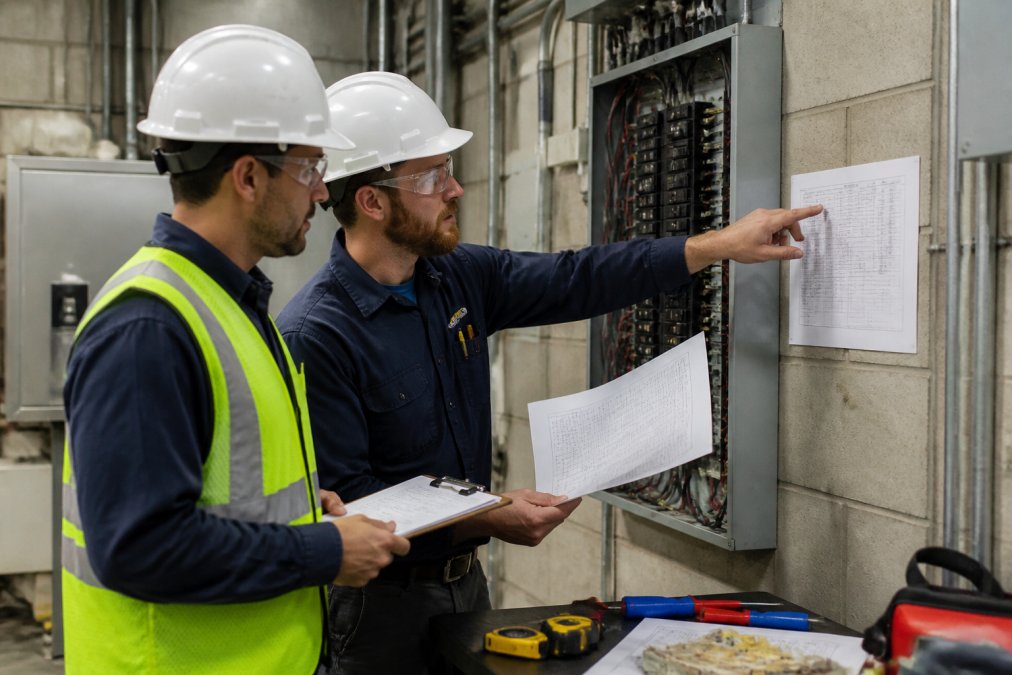
The fastest way to filter candidates is to demand documentation before discussing a quote. A legitimate commercial electrical contractor hands over licensing, bonding, and insurance paperwork without hesitation. But paperwork only clears the first gate: owners who avoid bad hires verify credentials independently, interview against their building, and compare bids on scope rather than bottom-line number.
Licensing, Bonding, and Insurance Verification
Electrical licensing is the state-issued credential confirming an electrician has met training and examination requirements to work legally. Requirements vary: some jurisdictions license the contractor entity, others license individual journeymen and master electricians, and many require a master electrician to pull permits on commercial work. Confirm the company holds the right license and that the individual dispatched to your site is qualified under it.
Verify three separate documents: the contractor's license, a surety bond, and a certificate of insurance showing general liability and workers' compensation coverage.
Ask for the license number and confirm it with the issuing authority rather than trusting a photocopy; most state licensing boards publish an online lookup. Don't accept a certificate of insurance at face value, call the insurer to confirm the policy is active, covers your project window, and covers commercial work. Ask to be listed as a certificate holder or additional insured so you're notified if coverage lapses mid-project. If an uninsured electrician is injured on your property, the liability can land on you.
Experience with Commercial Electrical Projects
Commercial electrical systems differ substantially from residential ones. Three-phase power distribution, commercial panel schedules, emergency lighting circuits, and load balancing across multiple tenants require field experience a residential-only electrician may lack.
Ask about commercial electrical projects comparable to yours. A contractor who has wired restaurants, retail build-outs, or light industrial spaces understands the inspection requirements and downtime constraints you face. Push past general claims: ask for the project type, the size of the service, and what the inspection process looked like. A contractor who has pulled permits and passed inspections locally already knows the authority having jurisdiction (AHJ) and its quirks, which shortens your timeline.
Interview Questions That Separate Qualified Contractors from Bidders
Treat the first site visit as an interview. These questions separate contractors who can execute from those who can only quote.
- Who will actually be on site? Ask whether the company uses its own employees or subcontracts the work, and get the name and license status of the supervising electrician.
- How do you handle permits and inspections? The contractor should pull the permit, schedule the inspection, and provide the signed inspection card. If they suggest skipping the permit, end the conversation.
- What is your change-order process? Ask how they document scope changes, who approves them, and how they price them. A clear written process protects both sides.
- How do you handle after-hours and emergency response? Get the actual response window in writing, not a verbal "we're available 24/7."
- Can you provide three commercial references from the last 12 months? Call them. Ask whether the project finished on schedule, whether the final invoice matched the quote, and whether the contractor returned for punch-list items.
How to Compare Bids Without Getting Burned
Comparing bids on price alone is the most common way business owners overpay. Two quotes for the same panel upgrade can differ by thousands because one excludes permit fees, temporary power, or after-hours work.
Build a scope sheet before requesting quotes: the work you want done, the outage hours your business can tolerate, and required closeout documentation (as-built drawings, panel schedules, test results). Send it to every bidder, then compare line by line, labor hours, material allowances, permit and inspection fees, and exclusions. The lowest number is often the one with the most exclusions.
What Commercial Electrical Work Actually Costs
Pricing for commercial electrical services depends on scope, site conditions, and urgency. Reputable contractors provide itemized estimates separating labor, materials, permits, and after-hours premiums. Rather than memorizing a national average, understand the variables that move your number and the contract structures that control total spend.
Hourly Rates, Shift Premiums, and Overtime Pay
Commercial electrical pricing typically breaks into an hourly base rate plus adjustments. Emergency calls, weekend work, and holiday shifts carry premiums because the contractor pays their own team overtime to respond. Under the federal Fair Labor Standards Act, covered nonexempt employees must receive at least one and one-half times their regular rate beyond 40 hours in a workweek, which is why after-hours work costs more than the same labor on a Tuesday morning (dol.gov).
| Pricing Component | What It Covers | When It Applies |
|---|---|---|
| Hourly base rate | Standard labor during business hours | Scheduled maintenance and installs |
| Shift premium | Evening or overnight labor | After-hours work at your request |
| Overtime pay | Labor beyond a standard shift | Emergency repairs, tight deadlines |
| Trip or diagnostic fee | First-hour assessment and travel | Troubleshooting calls |
| Project-based quote | Fixed scope, labor, and materials | Build-outs and defined upgrades |
| Time-and-materials (T&M) | Actual hours plus marked-up materials | Undefined or exploratory work |
The Cost Drivers That Actually Move Your Number
When a contractor says the price "depends," these are the variables they mean. Knowing them lets you ask better questions and sometimes reduce the number before work starts.
- Service capacity and panel condition. If your existing service can't carry the new load, a panel upgrade or new subpanel enters the scope, the difference between a modest install and a major project.
- Access and routing. Distance from the panel to the work area, whether conduit runs exposed or must be fished through finished walls, and whether trenching or concrete work is required all add labor hours.
- Permits and inspections. Permit fees are set by the local jurisdiction and vary by scope. They are a pass-through cost, not a contractor markup, and a quote that omits them is not a lower price.
- Downtime constraints. Work that must happen after hours to keep your business open carries shift premiums. If your operation can tolerate a scheduled daytime outage, you can often avoid that premium entirely.
- Materials and lead times. Switchgear, breakers, and specialty fixtures can carry long lead times. Expedited procurement costs more, and a contractor who flags a lead-time risk early is doing you a favor.
- Site conditions. Older buildings frequently have undocumented wiring, aluminum conductors, or previous work that doesn't meet current code. Remediation is real labor, and a thorough contractor will price it as a line item rather than discover it mid-project.
The honest answer on cost: it depends on your building, your panel capacity, and how much work can be scheduled versus rushed. Ask for a written breakdown and which line items you could reduce by adjusting schedule or scope.
Project-Based vs. Full-Time Hiring Models
Project-based hiring suits defined scopes: a panel upgrade, tenant build-out, or specific installation. You get a fixed quote and completion date, and the contractor manages their own crew. Retainer arrangements suit property managers and multi-site operators who need consistent response times and preventative maintenance. The trade-off is commitment versus flexibility, if your space runs critical equipment, a maintenance relationship usually beats calling around during an emergency.
The decision is a cost-benefit analysis between three structures:
- Project-based contract. Best for one-time scopes with a clear endpoint. You pay a fixed price for a defined deliverable, and your exposure ends at completion. The risk is that undefined conditions become change orders.
- Time-and-materials (T&M). Best for troubleshooting or work whose scope can't be known in advance. You pay for actual hours and materials, usually with a markup on parts. It's transparent but open-ended, so ask for a not-to-exceed cap.
- Retainer or maintenance agreement. Best for owners who want predictable response times and scheduled preventive work. You commit to a recurring fee in exchange for priority scheduling and documented inspections.
In-House Electrician vs. Contracting a Commercial Electrical Firm
Should you hire an electrician onto your payroll or contract a commercial electrical firm? It depends on volume and criticality.
In-house makes sense when you have enough ongoing work to keep a licensed journeyman busy full time, when response speed is mission-critical, and when you can carry the overhead: wages, payroll taxes, workers' compensation, benefits, a service vehicle, tools, and continuing education. You also take on the supervisory burden, since a lone in-house electrician still needs a licensed master or contractor of record to pull permits in most jurisdictions.
Contracting a commercial electrical firm makes sense when needs are episodic, the scope requires multiple electricians or specialty equipment, or you want licensing, insurance, and permit responsibility to sit with the vendor. You pay a higher hourly rate than raw wages but avoid fixed overhead and idle labor between projects. For most small and mid-size commercial properties, a hybrid approach works best: a maintenance agreement for routine and emergency work, plus project-based contracts for larger upgrades.
Commercial Electrical Safety Compliance Standards You Need to Know
Commercial electrical safety compliance standards prevent fire, shock, and equipment failure, and they carry legal weight. The primary framework is the National Electrical Code, published by the National Fire Protection Association and adopted by jurisdictions across the country, governing how electrical systems must be installed and maintained.
For ongoing maintenance, NFPA 70B, Standard for Electrical Equipment Maintenance outlines recommended practices for keeping commercial electrical infrastructure in safe working condition, including routine inspection intervals and testing procedures.
Your contractor should also be able to document OSHA electrical safety requirements compliance for any work performed on energized or high-voltage systems. Ask how they handle lockout/tagout procedures and arc-flash risk assessment. A contractor who can't answer those questions clearly is a compliance risk, not just a quality risk.
Why a Commercial Electrical Maintenance Contract Saves Money
A commercial electrical maintenance contract converts unpredictable emergency spending into a planned line item. Scheduled inspections catch degradation early, when repairs are cheaper and downtime is avoidable.
A well-structured contract typically includes periodic infrared thermography scans of panels and connections, torque checks on terminations, ground-fault protection testing, and a written report after each visit. That schedule matters because most failures start as small, invisible issues: a loose connection heating up, a breaker losing capacity, insulation degrading behind a wall.
The real value isn't the repair you avoid, it's the business day you don't lose. For a restaurant or retail space, a single unplanned outage can wipe out a day of revenue and spoil inventory. Preventative maintenance stops that from becoming recurring.
The Cost of Commercial EV Charging Station Installation
The cost of commercial EV charging station installation varies widely based on how much electrical infrastructure your site already has. The biggest variable: whether your existing service panel can support the added load or needs an upgrade first.
Level 2 commercial chargers require a dedicated 240-volt circuit, and each unit draws significant amperage. Installing multiple stations often pushes a building past its current service capacity, putting a panel upgrade or new subpanel in scope.
Site conditions drive the rest: distance from the panel to the parking area, trenching, and concrete work for pedestals. A qualified contractor performs a load study before quoting so you know what your building can handle.
Hiring Commercial Electricians: Getting It Right the First Time
The gap between a good commercial electrical hire and a bad one shows up months later in failed inspections, emergency calls, and repair costs that never should have existed. Vet the license, verify insurance, ask about commercial project experience, and put compliance documentation in writing.
As a family-owned, licensed, bonded, and insured electrical contractor, EmergenServe handles commercial electrical projects, panel upgrades, preventative maintenance, and EV charger installation with same-day booking and 24/7 emergency availability. Our team provides professional troubleshooting and code-compliant installations.
If you're ready to stop gambling on your electrical infrastructure, get started with EmergenServe and schedule a service call today.
Frequently Asked Questions
How much does a commercial electrician cost per hour?
Rates depend on the electrician's experience level, the scope of work, and whether the job is scheduled or emergency. A journeyman electrician typically charges less than a master electrician, and after-hours calls carry shift premiums and overtime pay. For a specific quote on your project, contact EmergenServe directly. Pricing depends on the job scope, location within your facility, and parts needed.
What qualifications should I look for in a commercial electrical contractor?
Start with a valid contractor licensing in your state, active insurance and bonding, and proven field experience with commercial electrical projects. Ask whether the team includes journeyman and master electricians, whether they hold OSHA certification, and whether they can read blueprints and interpret the NEC. A contractor who handles commercial wiring, panel upgrades, and preventative maintenance regularly will be better prepared than one who mostly does residential work.
How do I verify if a commercial electrician is licensed and insured?
Ask for the license number and verify it through your state's licensing board. Request a certificate of insurance showing general liability and workers' compensation coverage, and confirm the bond is current. A legitimate electrical contractor will provide these documents without hesitation. If a provider cannot produce proof of contractor licensing, insurance, or bonding, that is a serious warning sign and you should look elsewhere.
What are the benefits of hiring a local, family-owned electrical contractor?
A local contractor knows the regional electrical code requirements, utility coordination, and common infrastructure issues in your area. A family-owned operation often provides more direct communication, consistent technicians, and accountability that larger staffing agencies may not. For businesses that need 24/7 emergency availability and same-day service, a local team with a proven response time is more reliable than a distant provider.