 how-to
Is a Federal Pacific Panel Safe? What Homeowners Must Know
Table of Contents
- Is a Federal Pacific Panel Safe? The Short Answer
- Why Stab-Lok Panels Fail: The History of the Safety Investigation
- How to Identify a Federal Pacific Stab-Lok Panel
- Signs of a Faulty Electrical Panel: Beyond the Brand Name
- Homeowners Insurance and FPE Panels: Coverage and Cancellation Risks
- What to Do If You Have an FPE Panel: Inspection and Replacement
- FPE Stab-Lok Panel Replacement Cost and Negotiation Strategies
- Conclusion: Prioritize Your Family's Safety
- Frequently Asked Questions
Last Updated: September 5, 2026
Is a Federal Pacific Panel Safe? The Short Answer
The short answer is no: a Federal Pacific panel is not considered safe by modern electrical standards, primarily because its Stab-Lok circuit breakers have a documented history of failing to trip during overloads. This guide from EmergenServe explains what makes the federal pacific panel dangerous, how to identify one, and the practical steps to protect your family and property.
A federal pacific panel is an electrical load center manufactured by Federal Pacific Electric Company, most commonly installed in homes built between 1950 and 1980. The core issue is the Stab-Lok circuit breakers: when one fails to trip during an overload, the wiring can overheat to the point of ignition without the panel signaling any problem, creating a silent fire hazard.
Why Stab-Lok Panels Fail: The History of the Safety Investigation
The safety concerns are not new. Independent testing in the early 1980s revealed that a significant portion of Stab-Lok breakers failed to trip under overload conditions, findings later supported by investigations of panels pulled from active service.
The failure mechanism is rooted in the breaker's internal calibration: the thermal element that should trip the switch was inconsistent or degraded over time, resulting in a breaker that requires far more current than rated to trip, or does not trip at all.
The Failure to Trip on Overload
The "failure to trip" is the single most dangerous characteristic. When a breaker fails, the branch circuit continues delivering power to an overheating line, leading to electrical fires behind walls and inside outlets. Unlike a properly functioning panel that cuts power in milliseconds, a faulty FPE panel may allow wire insulation to melt and ignite.
This is not a theoretical risk. Home inspectors across the country routinely flag FPE panels as a hazard during real estate transactions, and many insurance carriers have taken the position that these panels are uninsurable due to the elevated fire risk. The Consumer Product Safety Commission's historical review of Federal Pacific panels documented the scope of the testing failures, though the agency never issued a formal recall, which leaves the burden of action on homeowners.
How to Identify a Federal Pacific Stab-Lok Panel
Identifying an FPE Stab-Lok panel is a two-step process: confirm the brand, then verify the breaker design. Always confirm the final diagnosis with a licensed electrician.
Step 1: Check the Panel Door and Interior Label
The most obvious marker is the brand name printed on the inside of the panel door. Open the door and look for the label, which typically reads "Stab-Lok" in bold red lettering with "Federal Pacific" below it. In some models, the label is on the interior side of the door; in others, it is a sticker on the panel's interior backplate near the main breaker.
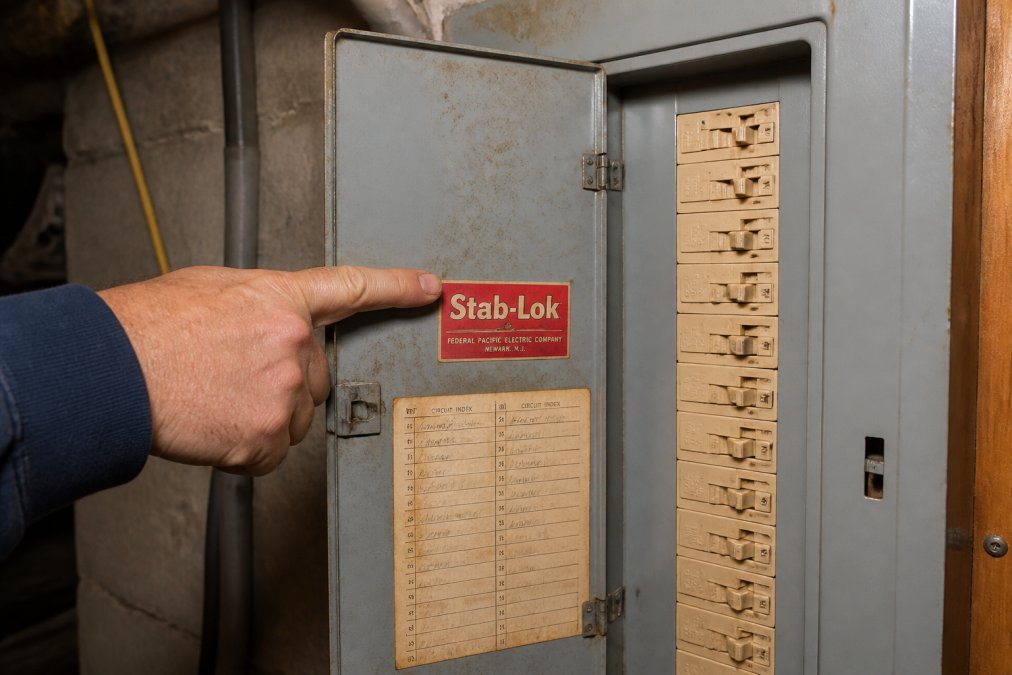
If the label is missing or painted over, look for a rating sticker listing the model number and manufacturer. FPE also used the names "FPE," "Federal Pacific," and, in later runs, "Reliance," which is functionally the same hazard.
Step 2: Examine the Breaker Design
The breakers themselves are the second, more reliable visual clue. Stab-Lok breakers are distinctive in three ways:
- Color and shape: They are typically beige or tan with a flat, rectangular face. The handle is a simple toggle that sits flush with the breaker body.
- Stab-in connection: Unlike modern breakers that bolt onto the bus bar or slide into a rail, Stab-Lok breakers push straight onto a metal stab. You can often see the metal bus bar tabs exposed between the breakers, which is a design quirk not found in most other panels.
- No visible mounting screw: Each breaker is held in place by the tension of the stab connection, not by a screw or clip. If you look closely at the breaker's base, you will not see a screw hole or a retaining clip.
Step 3: Check the Main Breaker and Sub-Panels
If the main panel does not show an FPE label, check the main breaker itself, as many have "Federal Pacific" stamped into the handle. Also check sub-panels in the garage, basement, or utility room; it is not uncommon for a home to have a modern main panel but an older FPE sub-panel.
What to Do If You Are Unsure
If you see any of these signs, or are unsure because the panel is old and labels are worn, the next step is a professional inspection to confirm the manufacturer and model and whether the panel has been partially upgraded.
Signs of a Faulty Electrical Panel: Beyond the Brand Name
A federal pacific panel is not the only panel that can develop problems. Age, corrosion, and improper installation can compromise any breaker box, so know the general signs of a faulty panel regardless of brand.
- Frequent breaker trips: While annoying, breakers that trip often are at least working. The real danger is a breaker that never trips, even when you intentionally overload a circuit.
- Burning smell or discoloration: A distinct odor of burnt plastic near the panel, or visible scorch marks on the breakers or the enclosure, points to overheating components.
- Warm panel face: The front cover of the panel should never feel warm to the touch. Heat indicates loose connections or failing breakers.
- Flickering lights: If lights dim or flicker when you turn on high-draw appliances, the panel or the branch circuit may have a loose connection.
- Rust or corrosion: Moisture intrusion inside the panel can corrode the bus bar and breaker contacts, leading to arcing and electrical shock hazards.
A common mistake is assuming a panel that "has never given us trouble" is safe. The failure mode of an FPE panel is often silent until a fire. Thermal imaging can reveal hot spots, but the absence of heat does not clear a Stab-Lok panel, because the defect is in the trip mechanism itself.
Homeowners Insurance and FPE Panels: Coverage and Cancellation Risks
The presence of a federal pacific panel can directly affect your homeowners insurance. Many carriers maintain internal lists of "unacceptable" panels, and FPE Stab-Lok is routinely at the top. When an insurer learns of the panel, common outcomes are denial of new coverage, non-renewal, or a requirement to replace the panel within a set timeframe.
The insurance implication creates a practical urgency that goes beyond safety. If your carrier cancels your policy, finding a new one with a known FPE panel in the home is difficult and often expensive. Some homeowners end up in the surplus lines market, paying significantly higher premiums for coverage that a standard carrier would provide at a lower rate. The Insurance Institute for Business & Home Safety guidance on electrical hazards underscores how insurers view aging electrical systems as a primary driver of residential fire claims.
How to Talk to Your Insurance Provider
A proactive, documented conversation with your insurer is far more effective than waiting for a cancellation notice:
- Get a professional inspection first. Have a licensed electrician inspect the panel and provide a written report stating the manufacturer, the condition of the breakers, and a clear recommendation. If no immediate signs of overheating exist, the report can say the panel is "currently functioning but is a known fire hazard due to the breaker design."
- Call your agent, not the claims department. Explain that you have had a professional inspection and are proactively addressing a known issue. Ask directly: "Does my current policy cover this panel, and are there any exclusions or non-renewal risks I should know about?"
- Ask about a timeline for replacement. Some insurers will keep your policy active if you provide a signed contract for panel replacement within a specific period, often 30 to 60 days. Get the timeline in writing.
- Do not hide the panel. If a claim is later filed and the adjuster discovers a known fire hazard that was not disclosed, the carrier can deny the claim entirely. This is the single most important rule in this entire process.
What to Do If Your Policy Is Canceled or Denied
If your carrier issues a non-renewal notice or denies a new application because of the panel, you have options:
- Ask for the underwriting guidelines. Insurers must provide a reason for the denial or non-renewal. Ask your agent for the specific underwriting bulletin that lists FPE panels as unacceptable; sometimes the issue is not the panel itself but the absence of a recent electrical inspection.
- Request a re-inspection. If the denial is based on a general concern about aging electrical systems, a recent inspection documenting the panel's current condition and any upgrades can sometimes change the underwriter's decision.
- Shop with a broker. A licensed broker who works with multiple carriers can help you find a company that does not automatically exclude FPE panels; some regional carriers and mutual companies have more flexible underwriting standards.
- Consider a stated-value or fire-only policy as a bridge. If you cannot find standard coverage, a fire-only policy or a surplus lines policy can keep you protected while you arrange for replacement. These are more expensive but serve as a temporary bridge, not a permanent solution.
The Bottom Line for Homeowners
The insurance market has effectively made the decision for you: if you have an FPE panel, replacement is not a matter of if but when. Scheduling the replacement before your insurer forces the issue gives you control over the contractor, the timeline, and the cost.
What to Do If You Have an FPE Panel: Inspection and Replacement
If you have confirmed your home contains an FPE Stab-Lok panel, the next step is a professional evaluation. A licensed electrician should open the panel, assess the bus bar, check for overheating, and verify amperage ratings to confirm whether the panel is original or partially upgraded.
The industry consensus is clear: the only permanent fix for a federal pacific panel is full replacement. Retrofitting new breakers into an old FPE enclosure is not a viable solution, because the bus bar and the panel design itself are part of the problem. The replacement involves removing the old panel, installing a new load center from a modern manufacturer, and re-terminating all branch circuit wires. This is a job for a licensed professional, not a DIY project, because the work must comply with the National Electrical Code requirements for service panels and local building codes.
FPE Stab-Lok Panel Replacement Cost and Negotiation Strategies
The FPE Stab-Lok panel replacement cost varies based on service amperage, wiring condition, and local labor rates. While we cannot provide a specific figure, homeowners should budget for a new panel, new breakers, and several hours of labor. The cost is an investment in safety and insurability that removes a known defect from the inspection report.
If a home inspection has flagged the FPE panel during a real estate transaction, a common strategy is to request a credit at closing equal to a licensed electrician's quote for replacement, rather than asking the seller to perform the work, giving you control over the contractor and quality.
For homeowners not selling, consider the replacement a priority expense, not a discretionary upgrade. Many electricians offer same-day booking and can complete a standard panel swap in a single visit.
Conclusion: Prioritize Your Family's Safety
A federal pacific panel is a known fire hazard that no homeowner should ignore, regardless of whether it has "worked fine" for decades. The risk of a breaker failing to trip is too great, and the insurance implications too severe, to justify waiting for a sign of trouble.
At EmergenServe, we are a licensed, bonded, and insured electrical contractor serving the Charleston Lowcountry, and we specialize in panel upgrades and code-compliant installations. Our team provides 24/7 emergency service with a 60-minute response time, and we bring the same urgency to a scheduled panel replacement as we do to an after-hours outage. Schedule service with EmergenServe today to have your panel inspected by a professional who will do the job right the first time and give you the peace of mind that comes with knowing your home is safe.
Frequently Asked Questions
Should I replace my Federal Pacific panel?
Yes, most experts recommend replacing a Federal Pacific panel, especially if it contains Stab-Lok breakers. The documented failure-to-trip issue means breakers may not shut off during an overload, creating a serious fire hazard. Since these panels are aging and parts are hard to source, replacement is the safest option. A licensed electrician can assess your specific setup and provide a quote for a panel upgrade.
Are Federal Pacific electrical panels recalled?
There was no official recall of the panels, which is part of why the situation is confusing for homeowners. However, a 1980 investigation by the Consumer Product Safety Commission (CPSC) found serious problems, including breakers failing to trip during testing. While the CPSC did not mandate a recall, the evidence led many in the industry to consider them a significant fire hazard and a defective product.
Does homeowners insurance cover FPE panel replacement?
Typically, your homeowners insurance will not cover the cost to replace a Federal Pacific panel, since it is considered a pre-existing condition and a known hazard. However, the presence of an FPE panel can affect your coverage. Many insurers will refuse to write a new policy or may cancel an existing one until the panel is replaced. Contact your agent to confirm your policy's status.
How can I tell if I have a Federal Pacific Stab-Lok panel?
Open the door of your breaker panel. Look for the brand name 'Federal Pacific' or the model name 'Stab-Lok' printed on the inside label. The breakers themselves are often a distinctive beige or tan color. Another clue is that the main breaker switch may be labeled 'Stab-Lok.' If you see these signs, do not attempt to work on it and call a licensed electrician for a professional assessment.