 how-to
Commercial Electrical Maintenance for Restaurants
Table of Contents
- Why Commercial Electrical Maintenance for Restaurants Is Non-Negotiable
- Signs of Electrical Overload in Restaurants You Should Never Ignore
- Your Commercial Kitchen Electrical Safety Checklist
- How to Build a Preventative Maintenance Schedule That Prevents Downtime
- Emergency Electrical Repair for Restaurants: What to Do Before Help Arrives
- Smart Monitoring and Energy Efficiency Upgrades That Pay for Themselves
- Choosing a Commercial Electrical Contractor for Your Restaurant
- Frequently Asked Questions
Last Updated: September 30, 2026
Why Commercial Electrical Maintenance for Restaurants Is Non-Negotiable
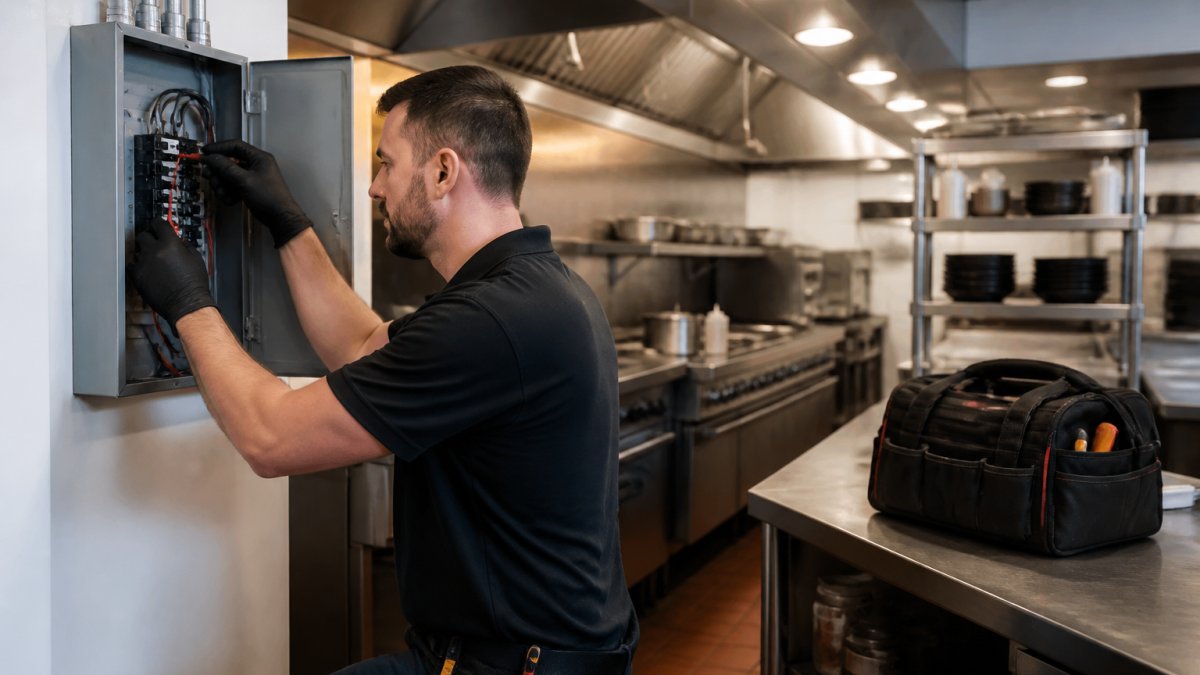
A restaurant's electrical system runs harder than almost any other commercial space. Kitchens pull heavy loads from ovens, fryers, and refrigeration all at once. One weak connection can shut you down mid-service.
That's why commercial electrical maintenance for restaurants is not a "nice to have." It's the difference between a full dining room and a dark one.
At EmergenServe, we've seen how fast small issues turn into lost revenue. A tripped breaker during dinner rush means cold food, angry guests, and refunds. A worn outlet behind a fryer can spark a fire.
The stakes are simple: downtime costs money, and safety risks cost more. Regular inspections catch problems before they cost you a night of business.
This guide covers the warning signs, a working checklist, and how to build a schedule that keeps your kitchen running. Below, we'll show you exactly how to protect your operation.
Signs of Electrical Overload in Restaurants You Should Never Ignore
Electrical overload in restaurants happens when your system draws more power than its circuits can safely handle. The warning signs show up before a full failure, if you know where to look.
Watch for these signals:
- Breakers that trip again and again during peak hours
- Lights that dim or flicker when kitchen equipment kicks on
- Warm or discolored outlet covers and switch plates
- A burning smell near panels or appliances
- Buzzing sounds from outlets, switches, or the breaker panel
Voltage fluctuations are one of the clearest clues. When a large appliance starts and your lights dip, that circuit is strained.
Many operators ignore these signs until something fails. A common mistake is resetting a breaker and moving on. That fixes nothing. It just delays the failure.
If you spot any of these, call a licensed electrician. Repeated tripping is your system asking for help.
Your Commercial Kitchen Electrical Safety Checklist
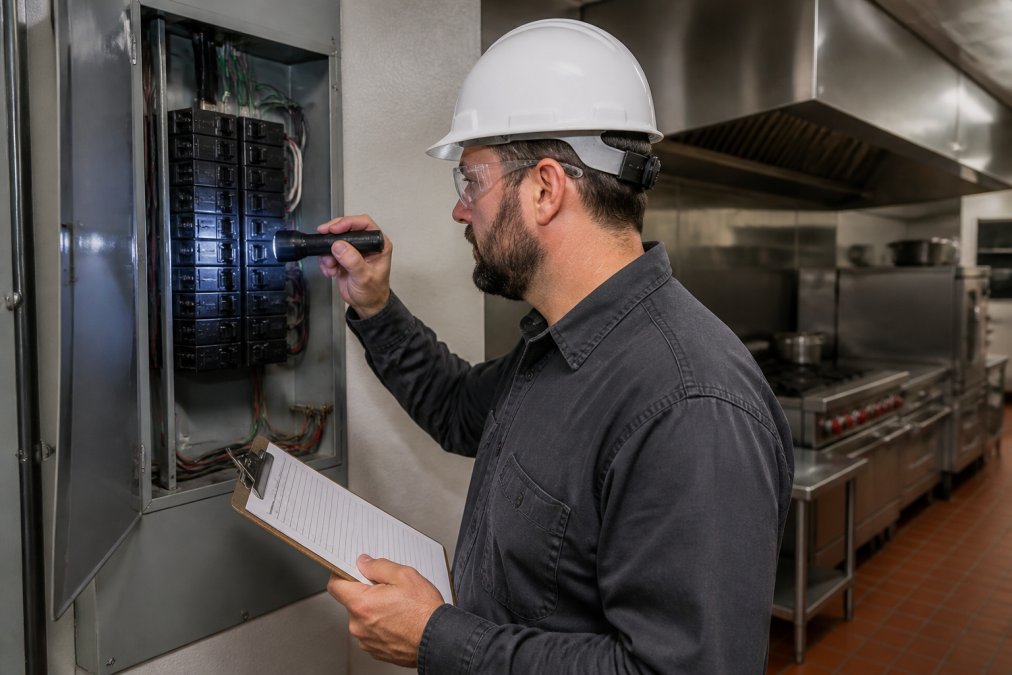
Use this commercial kitchen electrical safety checklist every month. It takes about 20 minutes and can prevent a shutdown.
- Test all GFCI outlets in wet areas like dish stations and prep sinks
- Check that breaker panels are clear of grease, dust, and stored items
- Look for frayed cords or cracked plugs on all appliances
- Confirm hood exhaust systems and their wiring are working
- Feel outlet covers for heat (use the back of your hand)
- Check that refrigeration electrical systems have dedicated circuits
- Note any flickering lights or buzzing sounds
- Confirm all panels are labeled and accessible
How to Build a Preventative Maintenance Schedule That Prevents Downtime
A preventative maintenance schedule spreads tasks across the year so nothing gets missed. Here's how to build one:
- List every electrical asset. Panels, outlets, hood systems, refrigeration, and kitchen equipment.
- Set a frequency for each. Monthly for safety checks, quarterly for panels, yearly for full inspections.
- Assign an owner. Someone on staff checks the basics. A licensed electrician handles the rest.
- Log every issue. Track what tripped, when, and what fixed it.
- Review quarterly. Look for patterns, like the same circuit failing.
| Task | Frequency | Who Does It |
|---|---|---|
| GFCI outlet testing | Monthly | Staff |
| Panel inspection | Quarterly | Electrician |
| Full safety inspection | Annually | Electrician |
| Refrigeration circuit check | Every 6 months | Electrician |
| Hood system wiring check | Every 6 months | Electrician |
What is the ROI of a maintenance schedule?
The ROI comes from avoided downtime. One lost dinner service can cost more than a year of scheduled maintenance. Fewer breakdowns also extend the life of your equipment, so you replace it less often.
Emergency Electrical Repair for Restaurants: What to Do Before Help Arrives
- Turn off the affected breaker if you can reach it safely
- Move staff and guests away from sparking or smoking outlets
- Do not touch wet equipment or stand in water near panels
- Shut off gas to kitchen equipment if you smell burning
- Call for emergency electrical repair right away
EmergenServe offers 24/7 emergency repairs with a 60-minute response time. That matters when your panel is sparking at 2 AM and you can't wait until morning.
Smart Monitoring and Energy Efficiency Upgrades That Pay for Themselves
Most restaurant electrical content stops at "install LEDs and save money." That advice is a decade old. The operators pulling ahead right now are using two newer levers: real-time circuit monitoring and targeted efficiency retrofits with a measurable payback. Here's how each actually works.
How smart monitoring catches failures before they happen
A smart monitoring system installs current transformers (CTs) around the conductors feeding your panels and major equipment circuits. Those sensors sample current draw continuously, often every few seconds, and stream the data to a dashboard or app.
- A refrigeration circuit drawing steadily higher amps over weeks usually means a failing compressor or dirty condenser coils, a problem you can schedule instead of discovering at 6 PM on a Friday.
- A circuit that spikes briefly and repeatedly may indicate a loose connection or a motor starting under load.
- A panel running hotter than its historical average can point to imbalance or a degrading breaker.
Energy efficiency upgrades with a real payback
Efficiency work pays back fastest when you target the biggest loads first. In most kitchens, that's refrigeration, HVAC, and lighting, in roughly that order.
- LED retrofits. Replacing fluorescent tubes and incandescent lamps with LED equivalents cuts lighting wattage substantially and reduces heat load, which in turn eases the burden on your HVAC. Many utilities offer commercial rebates that shorten the payback further, check your utility's business efficiency program before you buy.
- Electronically commutated (EC) motors. These are variable-speed motors used in refrigeration evaporators and HVAC fans. They ramp speed to match demand instead of running full-tilt, which lowers both energy use and wear.
- Occupancy and daylight sensors. Storage rooms, walk-ins, and back-of-house corridors sit empty for large parts of the day. Sensors eliminate the wasted hours.
- Anti-sweat heater controls. On reach-in and display refrigeration, these controls cycle door heaters based on actual humidity instead of running constantly.
- Power factor correction. If your utility bills for reactive power, capacitors at the panel can reduce that charge. Ask your electrician whether your rate structure makes this worthwhile.
How to calculate payback without guessing
You don't need an engineering study. You need three numbers:
- Current draw of the equipment (nameplate amps or a measured reading from your electrician).
- Hours of operation per year (be honest about overnight and off-hours).
- Your blended electric rate from a recent utility bill, in dollars per kilowatt-hour.
Where sustainability fits
Pair any upgrade with a preventative service agreement. The savings only compound if the new equipment is maintained, and the monitoring data is only useful if someone is acting on it.
Choosing a Commercial Electrical Contractor for Your Restaurant
Ask these questions before you hire:
- Are you licensed, bonded, and insured?
- Do you handle commercial kitchen wiring and panel upgrades?
- Can you respond to emergencies after hours?
- Do you offer a preventative service agreement?
- Can you provide references from other restaurants?
EmergenServe is licensed, bonded, and insured, with a 5.0 star rating from 28+ reviews. We're a locally owned family business, and we handle everything from panel upgrades to hood system wiring. One customer put it simply: the technician was knowledgeable and even taught them how to prevent future problems.
Frequently Asked Questions
How often should restaurants perform electrical maintenance?
Most commercial kitchens benefit from a professional electrical safety inspection at least once a year, with quarterly checks on high-use equipment like hood exhaust systems, refrigeration electrical systems, and commercial-grade outlets. Restaurants running heavy loads or older wiring may need inspections every six months. Between professional visits, staff should perform a preventative checklist monthly, checking for warm outlets, tripped breakers, and flickering lights.
What are the most common electrical issues in commercial kitchens?
The most frequent problems include overloaded circuits from too many appliances on one line, worn commercial-grade outlets near heat and moisture, failing ground fault circuit interrupter protection, and voltage fluctuations from refrigeration compressors cycling on and off. Hood exhaust systems and HVAC electrical integration also cause recurring issues because grease and heat degrade wiring over time. Catching these early prevents equipment downtime and reduces fire risk.
What should be included in a restaurant electrical maintenance checklist?
A solid checklist covers circuit breaker panel inspection, thermal imaging of the service panel and wiring, testing all ground fault circuit interrupter outlets, checking commercial-grade outlets for heat or discoloration, verifying hood exhaust system wiring, and confirming refrigeration electrical systems are drawing normal loads. It should also document voltage fluctuations, inspect lighting retrofits, and note any code compliance gaps for follow-up.
How do I find a reliable commercial electrical contractor for my restaurant?
Look for a licensed, bonded, and insured contractor with specific experience in commercial kitchen wiring and code compliance. Ask whether they offer 24/7 emergency repair for restaurants, how fast they can respond, and whether they provide post-inspection documentation. A contractor who specializes in commercial electrical maintenance will understand load balancing, fire hazard mitigation, and the operational continuity your business depends on.
A single electrical failure can wipe out a night of revenue and put your staff at risk. The fix is a real maintenance plan, not luck. EmergenServe handles commercial electrical maintenance for restaurants with 24/7 emergency availability, same-day booking, and a licensed, bonded, and insured team that knows kitchen systems inside and out. Get started with EmergenServe and keep your kitchen powered, safe, and open for business.